Information and Resources
Community Drop-In Sessions — March 2026
Two drop-in sessions are scheduled for residents to get information and ask questions:
- Thursday 12 March 2026, 4–7 PM — Thornton-Cleveleys FC, Gamble Road
- Tuesday 17 March 2026, 4–7 PM — Thornton-Cleveleys FC, Gamble Road
Representatives from Wyre Council's multi-agency team are expected to attend. You do not need to register — just turn up.
Source: Wyre Council, 5 March 2026📄 Community Information Handout
A one-page summary of key facts about PFAS contamination at Hillhouse — what's known, what the official advice is, and where to get help. Print-friendly for sharing with neighbours.
⚠ Allotment Closures — 5 March 2026
Two allotment sites in Thornton-Cleveleys have been closed following PFAS investigation results:
- Occupation Road Allotments — closed immediately. The Environment Agency has concluded this site meets the statutory criteria for formal classification as "Contaminated Land" under Part 2A of the Environmental Protection Act. Based on PFOA levels in both soil samples and produce, there is "a significant possibility it could cause significant harm to health."
- Sandringham Avenue Allotments — closed on a precautionary basis, pending scientific interpretation of soil sampling results.
This is the first formal Part 2A contaminated land classification connected to the Hillhouse investigation. If a formal determination is made, the council has stated it will "identify those responsible and secure remediation."
On allotments vs gardens: The official statement explains the distinction: "This risk is higher for allotment tenants because they are likely to eat more of the produce from the site as part of their regular diet than people who grow produce in their garden." Wyre Council has also separately confirmed (FAQ, updated October 2025) that regular consumers of garden produce could similarly exceed the EFSA safe intake threshold.
Source: Wyre Council, 5 March 2026 — "Further Steps Taken in Ongoing Multi-Agency Investigation"Current Official Advice
Wyre Council / FSA advice (as of 5 March 2026):
- Eggs: Do not eat eggs from poultry kept within 1km of the Hillhouse estate boundary (FSA/Wyre Council, 2 February 2026)
- Allotments (Occupation Road): Closed immediately — classified as Contaminated Land under Part 2A of the Environmental Protection Act (Wyre Council, 5 March 2026)
- Allotments (Sandringham Avenue): Closed precautionarily, pending soil sampling results (Wyre Council, 5 March 2026)
- Garden produce: Continue to wash and peel before eating; consider raised beds with fresh soil (FSA advice updated 5 March 2026)
- After gardening: Wash hands thoroughly after contact with soil
How effective is "wash and peel"?
The Environment Agency's Contaminated Land classification of Occupation Road Allotments was based on PFOA found within the produce itself, not only in surface soil. PFAS contamination in vegetables is the result of root uptake — plants absorb these chemicals from soil and water as they grow, incorporating them into plant tissue.
Washing and peeling removes surface soil, which does contain PFAS. It cannot remove PFAS that has been absorbed into plant tissue during growth.
The FSA continues to recommend washing and peeling for garden produce within 1km. The basis on which this is considered adequate — given that the EA's produce sampling confirmed systemic uptake of PFOA in allotment vegetables — has not been published.
Source: EA conclusion quoted in Wyre Council, 5 March 2026About the 1km boundary
The 1km egg advisory zone was set by Wyre Council and the FSA. No publicly available document explains how this distance was determined or what modelling — if any — was used to choose it.
Definition inconsistencies: Across Wyre Council's official documents, the zone has been described in at least three different ways: "within 1km of the Hillhouse estate boundary," "within 1km of the Hillhouse Technology Enterprise Zone," and "within 1km of the AGC Chemicals Europe facility." These are not the same perimeter. No map of the zone has been published. No measurement point or methodology has been specified.
When asked directly via FOI about how the zone was defined (Question 5), Wyre Council redirected the question to the Environment Agency. The council implementing the advisory zone has not, in a direct FOI response, explained how the zone boundary was determined.
Phase 2 soil sampling covered only council-owned land. Airborne PFAS from Hillhouse has been detected 20km away (Dalmijn et al., ES&T 2025). The true extent of contamination in the surrounding area is not yet known. Residents beyond 1km should not assume they are unaffected.
For context on how comparable sites in other countries have defined advisory zones, see The Numbers.
How the guidance has changed — 2024 to 2026
Official guidance has escalated significantly as investigation results have emerged:
| Date | Source | Guidance |
|---|---|---|
| July 2024 | Wyre Council letter to residents | Wash and peel garden produce; "continue to enjoy using your garden space as you normally would" |
| October 2024 | Wyre Council / FSA | Wash and peel; allotment holders written to about elevated PFOA in soil |
| March 2025 | Wyre Council Leader (BBC News, 7 March 2025) | Upgraded to "consider not eating" garden produce until more is known |
| October 2025 | Wyre Council FAQ | Confirmed regular allotment/garden consumers could exceed EFSA safe intake by 3–4× (rising to 7–8× including background dietary intake) |
| 2 February 2026 | FSA / Wyre Council | Do not eat eggs from poultry kept within 1km |
| 5 March 2026 | Wyre Council | Occupation Road Allotments formally classified as Contaminated Land (Part 2A). Sandringham Avenue Allotments closed precautionarily. New FSA advice: consider raised beds with fresh soil for gardens within 1km. Classification based on PFOA in both soil and produce |
Sources: Wyre Council letters July/October 2024; BBC News, 7 March 2025; Wyre Council FAQ, updated October 2025; Wyre Council, 5 March 2026
Scope of Current Advice
The current advice focuses on food consumption pathways. For context:
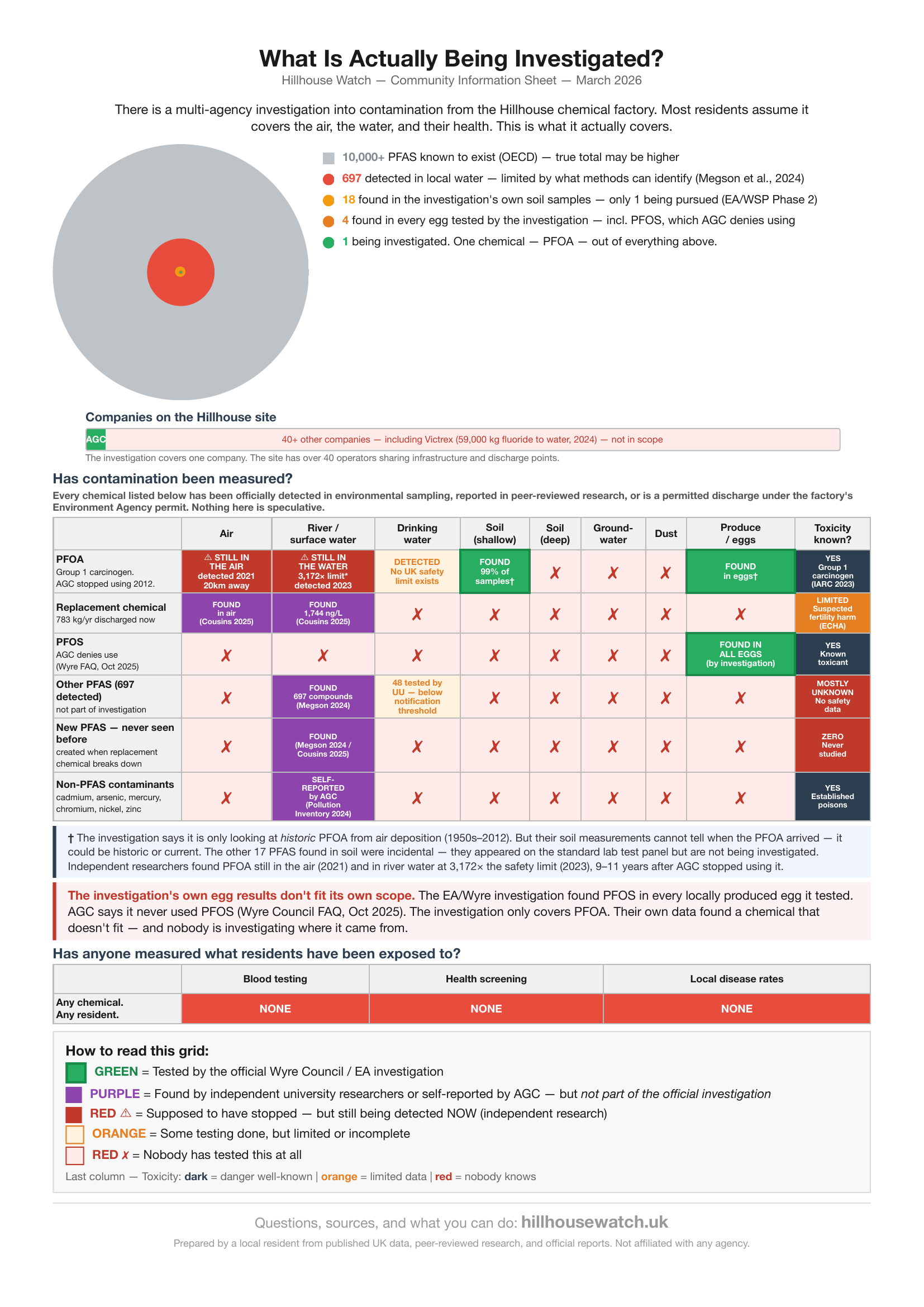
- The advice addresses food consumption but does not address breathing in chemicals — PFOA and EEA-NH4 have been detected in air up to 20km from the site (Dalmijn et al., ES&T 2025)
- No biomonitoring (blood and urine testing for residents) programme has been established
- EEA-NH4, the fluorochemical currently being discharged at approximately 800 kg/year, is not specifically addressed in current health advice
Water Quality Information
Drinking water supplied by United Utilities in the Thornton-Cleveleys area is tested and treated. For current information on water quality in your area, contact United Utilities directly.
Independent guidance on water treatment options is available from the Drinking Water Inspectorate.
Note: Decisions about additional home water treatment are a personal matter. This site does not provide product recommendations.
Community
- Facebook group: Hillhouse Watch — community discussion and updates
Official Updates
- Wyre Council mailing list: Subscribe to updates
- Multi-agency team queries: Contact via Wyre Council's PFAS page
- Community meetings: Next drop-in sessions: 12 and 17 March 2026, Thornton-Cleveleys FC, Gamble Road, 4–7 PM
Parliamentary Representation
Local MP:
- Lorraine Beavers MP (Blackpool North and Fleetwood)
National PFAS Plan — Parliamentary context:
- UK Government published its first national PFAS strategy on 3 February 2026: PFAS Plan: Building a Safer Future Together
- Emma Hardy MP challenged the plan in Parliament on compliance with "polluter pays" obligations under the Environment Act 2021 [UNVERIFIED — Hansard reference to be confirmed]
- Leigh Day is tracking whether the Defra PFAS plan meets the government's statutory obligations
Legal Information
Group litigation:
- Leigh Day, an environmental law firm, is investigating potential legal action relating to contamination from the Hillhouse estate
- Information: Leigh Day PFAS page
This site is not affiliated with Leigh Day and does not provide legal advice.
Documentation
Residents may wish to keep records of:
- Residential address and dates of residence
- Any relevant health information (in consultation with GP)
- Garden use and consumption of home-grown produce
- Dates of official communications received
Such documentation may be relevant for future health monitoring programmes or other purposes.